
The Wrong Problem Is Being Focused On
Instead of trying to “save college sports,” maybe we should “save college institutions.”

There is an initiative being led by politicians, lobbyists, school leadership, elected officials—anyone who benefited from the pre-NIL model—to revert to, or subvert, the current system. Tens of millions of dollars that are now being paid to athletes—money that had been generated for decades by schools—are suddenly being framed as a burden on athletic department budgets.
The national TV media rights package for the NFL was about $3 billion in 2010. If we assume a similar 1:10 ratio for college football postseason rights relative to the NFL, that would put college football around $300 million. By 2020, still in the pre-NIL era, those postseason rights would have grown to roughly $500 million annually, while the NFL’s media rights deals had climbed to around $5 billion before their most recent massive renegotiation.
That’s hundreds of millions of dollars per year in postseason media rights flowing to schools, executives, and bowl game leadership—anyone who could get their hand in the cookie jar. Everyone, that is, except the players—until recently.
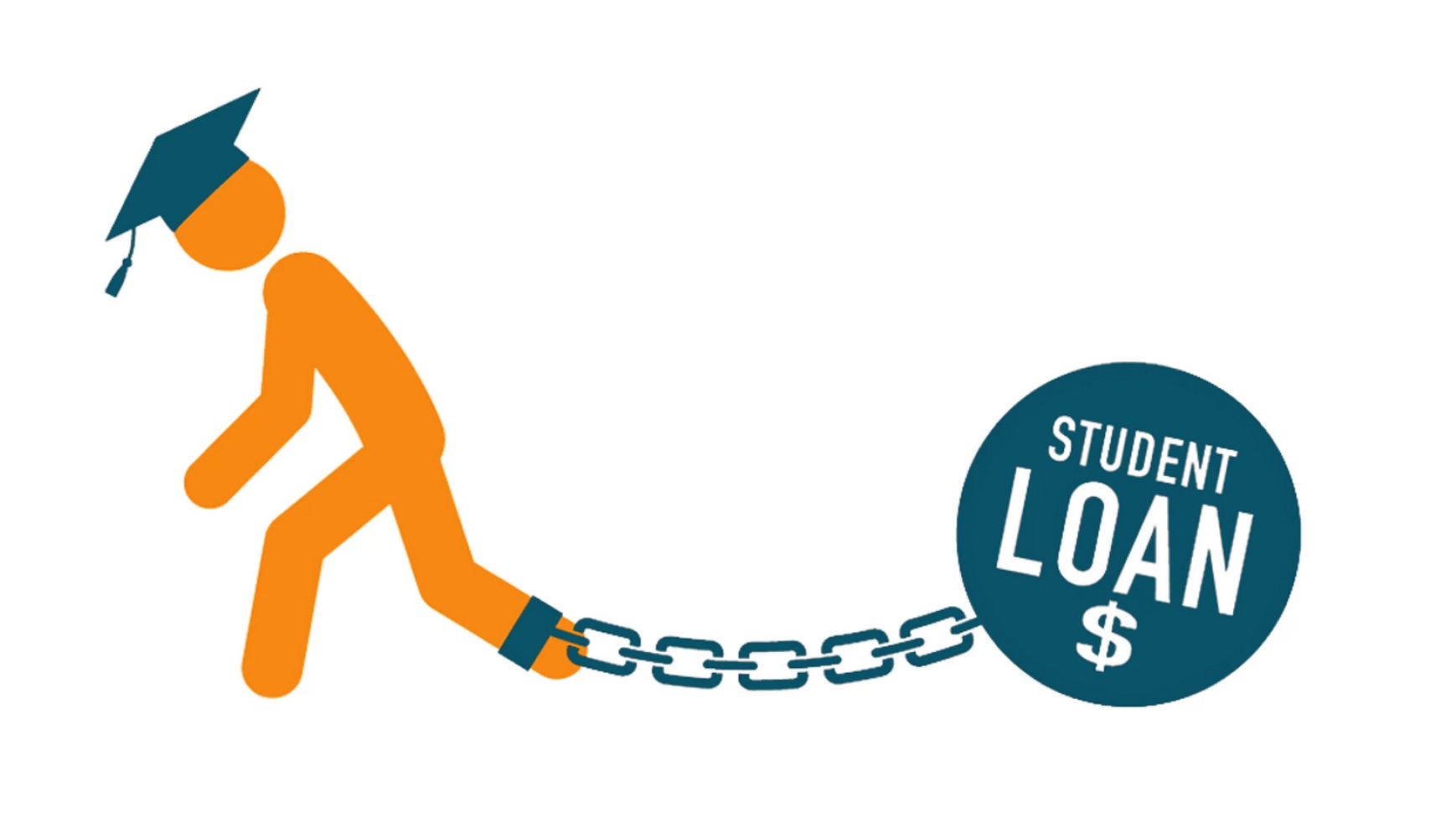
You can be a haphazard and reckless spender and have just about any debt forgiven—but not student loans. That’s because the perpetual flow of money between the state and universities relies on largely naïve and underinformed students taking on debt that forces rapid repayment at compounding interest rates. These rates are higher than auto loans and, in many cases, approach credit card levels.
You can’t simply opt out of paying for your education. The government won’t allow it. So what’s the solution when the national student loan default rate sits at 9.27%, according to College Factual? If you default, you accrue more interest and owe even more money.
Student loan debt in the U.S. is roughly $2 trillion—nearly double what it costs to run the federal government annually. That’s an astonishing number. We may print our way into oblivion to fund new wars, but at least those start with a defined budget.
The real issue is the systemic extraction of money from college students and their families. That’s what needs retooling. Instead of operating as degree mills that churn out graduates, institutions should be better aligned with helping students achieve meaningful career outcomes.
The underemployment rate tells a brutal story. Among recent graduates (ages 22–27), 42.5% are underemployed, according to the Federal Reserve Bank of New York—meaning they’re either not using their degree or not working enough hours to qualify as fully employed. Even across all college graduates, the underemployment rate sits at 34.4%.
What are we doing?
And yet, the NCAA is here to “help”—or so they claim.
Back in 2023, NCAA President Charlie Baker advocated for paying “at least half of a school’s eligible athletes at least $30,000.” That’s not reform—that’s a discount strategy. It’s an attempt to suppress the true market value of athletes while standing on the back of billions of dollars generated during the pre-NIL era.
Meanwhile, the estimated $140 billion in annual student loan interest payments isn’t going anywhere.
Baker also noted that there were 1,450 eligibility waiver requests, with about two-thirds approved. Roughly 30 cases went to court, meaning very few legal challenges have successfully pushed back against NCAA authority. Still, Baker has repeatedly argued that these waivers take opportunities away from high school athletes.
But who is actually limiting those opportunities?
When Baker says “high schoolers,” he’s not talking about “secondary school” broadly—he’s making an implicit appeal centered on American athletes. It’s an emotional argument designed to distract from a more complicated, and less comfortable, policy discussion: international athletes.
Texas Senate Bill 1319 attempted to restrict opportunities for international athletes. We already restrict work visas, green cards, and now even international goods through tariffs—so why not extend that logic to athletic scholarships?
Personally, I enjoy international athletes. They often bring a level of culture, perspective, and team value that enhances college sports. At the same time, we routinely point out that roughly 75% of U.S. Olympians come through the college system. So what role are we playing in developing athletes for other countries?
It’s a fair question—even if it makes people uncomfortable.
But you can’t argue for expanded opportunities for domestic athletes while selectively ignoring other factors that influence roster spots. That’s selective outrage—and it’s intellectually inconsistent.
You can’t have it both ways.
Maybe, instead of trying to “fix” college sports, we should start by fixing the university system itself—and the hundreds of billions of dollars it extracts annually in student loan interest payments.
Fix the system that charges students, not the one that pays athletes.