
The NCAA is Melting
The NCAA remains committed to fighting every lawsuit, no matter the outcome.

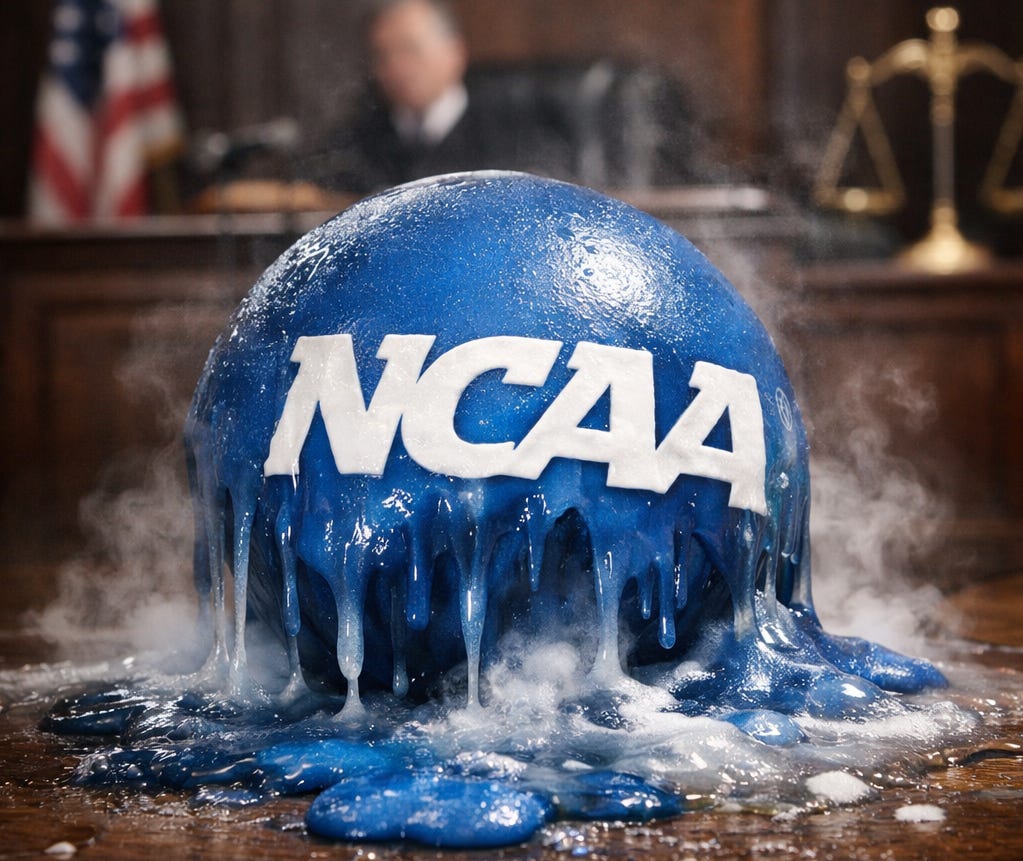
The Wicked Witch of the West, in the novel The Wizard of Oz, which was later crafted into a motion picture, [spoiler alert] ends up melting after getting water on her. A lifetime of evil had dried up the witch’s body, depriving her heart and organs of much-needed blood. Not too dissimilarly, the NCAA is finding itself drying up because of a lifetime of {mostly} evil.
Here are some relevant updates:
Last week, NCAA President Baker said of eligibility lawsuits, “We’re going to fight them all.” And that has proven to be the case recently, as even the most obvious and apparent lawsuits in favor of the athletes have been unnecessarily drawn out and contentious. For an organization designed to support athletes and their scholastic pursuits while competing athletically, the NCAA sure doesn’t seem to be representing the best interests of the very individuals it purports to protect.
The NCAA currently has a class action lawsuit being brought against it. The class action suit is brought by athletes who have already won an eligibility lawsuit, or who reasonably expect to be able to win one. When a class action lawsuit is brought by individuals representing a larger class of individuals who endured similar or identical circumstances, the ruling broadly and generally applies to everyone. Alas, the NCAA is going to force every deserving athlete to bring a lawsuit in order to gain their eligibility? I’m not sure that’s the way the law works, but no matter—the NCAA will blow more cash, not to help coaches or schools, but to make pursuing eligibility a necessary formality. Thanks for nothing!
This is not too dissimilar from public utilities that provide resources like energy at the direction of the state. So when the state wants to run power lines through a specific area where people live, and the project requires relocating one or more houses or residents, the public utility is glad to fight a lawsuit because it’s not their money or liability. Typically, the state and utility win because the benefit grossly outweighs the inconvenience and difficulty. But like the NCAA, the legal resource pockets are deep—except, unlike the NCAA, the public utility actually wins with some amount of regularity.
The NCAA is not just taking Ls in lawsuits involving players. Rest assured, this week they took an important step down a losing path against Jeremy Pruitt, who they have actively tried to block from coaching opportunities on the grounds of coaching infractions committed two years ago. I’m sure that the NCAA would have come out with any evidence they have—or any smoking gun they’ve obtained—about Jim Harbaugh’s complicity in the Michigan sign-stealing scandal surrounding Connor Stalions. But instead, all they have been able to produce is an L in the form of Chris Partridge being exonerated from any wrongdoing after he was terminated by Michigan during their national championship run and subsequently blocked by the exceptionally incompetent Michigan leadership from professional opportunities two offseasons ago. Of course, the Big Ten was also culpable in the Harbaugh demise by standing by during the attempt to bury Partridge through cataloguing, classifying, and documenting every personal text message over a period of several months. Have you ever had to clear your name from a wrongly brought allegation? I know people who have, and it absolutely sucks.
So how does this relate to the overarching focus of this newsletter (NIL)? Well, when you have this combative party on the other side of the negotiation table, you seemingly have no choice but to choose not to negotiate in good faith—because it would appear to be a waste of time and could only be seen as a likely stall tactic to bleed more months or years out of the fruitless organization formerly tasked with enforcing eligibility for athletes, but that now just cashes checks while lighting money on fire in a desperate hope for an antitrust exemption.
The antitrust exemption isn’t out of the question or off the table, but it’s not made more probable—or more fondly considered—with all of these distasteful and penal lawsuits being waged. Ultimately, the velocity of information sharing and the desperation for improved treatment for athletes, by athletes, should yield a scenario that eventually spells the elimination or massive overhaul of the NCAA. Don’t worry—the NCAA leaders will find safe harbor in bloated organizations like government or law firms, where mediocre achievers can hide from the objectivity of performance-based pay.
Here’s a Google review of the NCAA Headquarters that, though about food delivery, is more of a microcosm of what an entity like the NCAA should do:
“I really don’t know what these folks do, but I deliver to them often—large orders! In total, I have taken five orders and I have never once received any gratuity. I work for a third-party delivery company, and today was my final straw. I have given them multiple chances. They always say they will tip cash, and they never offer anything. It’s sad. I spent 45 minutes picking up their order, loading it into the car, delivering it to the incorrect address, only to be told an updated address. Upon arrival, they were super nice as always, but I just don’t understand why they don’t budget to be able to at least pay for our gas and time. Heck, five bucks would have helped toward at least paying for a portion of gas.
Again, I don’t know what this company does, but I do know that it takes food out of my family’s mouth when I’m wasting 45 minutes of my day for free, still having to turn around and invest gas money to bring somebody’s food that I don’t even know. I have notified my provider that I no longer wish to cater to this specific facility. It’s unfortunate, but people should take into consideration the time and effort we put in.”
At least it’s on brand!
[Special thanks to Google user “Doug D,” who has awarded dozens of five-star reviews but chose to give the NCAA one star.]