
Do Whatever You Want
NIL has created a vacuum of leaders and accountability.

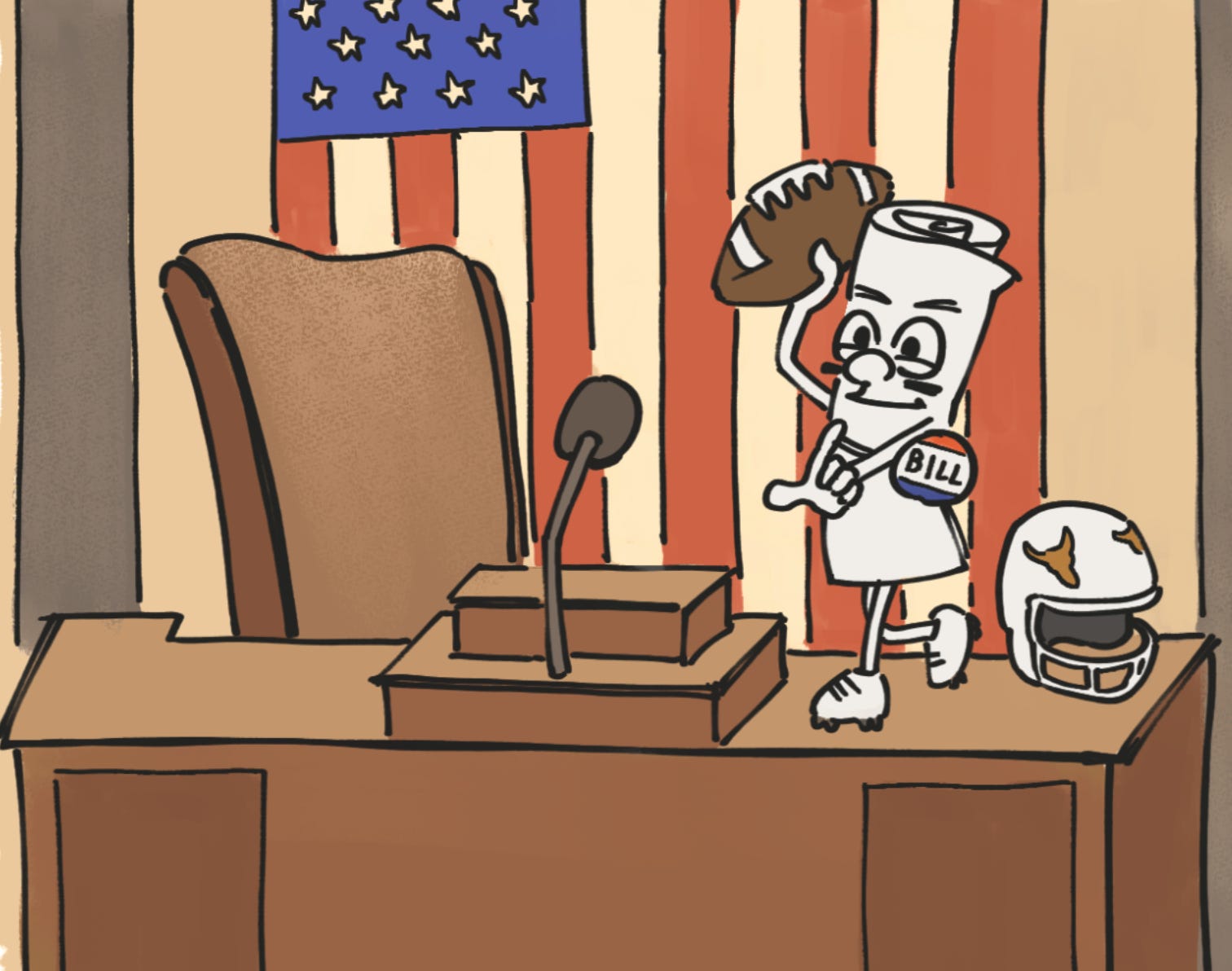
The President of the United States, along with his committees, councils, and a bunch of opportunists, is proposing short-term changes to the current college athletics system.
I refer to the people working on this “issue” as opportunists because, if they were actually trying to solve the problem maximally—or permanently—there would be some sort of labor and employment consideration.
Instead, the President’s next half-baked idea could look a lot like actions he has taken previously: high on headline generation and attention-grabbing, low on practical application.
As the government continues to try to jam through an antitrust exemption, one of the leading voices in NIL law, Sam Ehrlich, opines that assigning a task force to direct this unrepresented labor market—aka college athletics—would “very likely be unconstitutional.”
Welcome to the party, task force.
I won’t spend much time detailing the hypotheticals of what that task force could do, but Ross Dellinger’s reporting, at the very least, suggests that everyone is simply throwing ideas against the wall.
I couldn’t be less inspired.
The proposals aren’t inventive. They don’t materially push us forward in a better way. And they certainly aren’t trending toward legality.
But politicians haven’t much cared about what is legal and what isn’t.
As Congress prepares to potentially draft something for its members to vote on in the coming months, it appears the direction of these conversations will be informed by the consensus opinions shared across these committees.
Color me disappointed that there isn’t an explicit inclusion of student-athlete advisory councils, which already exist and would require very little activation to source meaningful feedback.
Instead, the overwhelming focus among this group of entitled appointees is “revenue enhancement and cost controls.”
Great.
But as Dale Carnegie posits in How to Win Friends and Influence People, it is often more beneficial—and easier—to focus on improving yourselves first.
Capping coach and leadership salaries is only going to force out good talent.
And I certainly haven’t heard any mention of exorbitant buyouts.
When fired coaches are making more money than every single athlete inside an athletic department, perhaps we’re examining the wrong problem.
There must be clarity on exactly what problem—or problems—we are trying to solve.
It sounds as though suppressing college athlete earning and transferring is the primary concern for what this presidential group of geniuses is truly trying to remedy.
And in doing so, this group may simply be adding more fuel to existing legal concerns surrounding NCAA antitrust behavior, student visa violations, Title IX complications, and undoubtedly much more.
We are the country of going big or going home.
We’re spending somewhere between $25 million and $150 million on our country’s 250th birthday this year—depending on which political party’s calculator you use and what actually gets reported.
Who cares if we ignore the rules? We’ve been ignoring rules forever.
Speed limits? Just suggestions.
A .08% BAC? Only if you want to have your wits about you while driving a 2,000-pound block of metal.
Weapons? Wherever you want, as long as you don’t get caught.
Pay taxes on non-qualified, tax-exempt scholarship expenses? No thanks—we’re good.
So who cares if people do whatever they want with college athletics going forward?
The motivation to behave outside the rules will almost always be higher for the rule-breaker than the motivation to follow them is for the compliant.
Part of these new proposals includes a hard cap on athlete compensation—yet another likely illegal element of this entire escapade.
Do we really think, even for a second, that 18-to-24-year-olds will decline or refuse additional payment from people aspiring to give it to them?
Illegal athlete payments have been happening for a long, long time. To suggest such payments would suddenly be restricted, curtailed, or reduced is comical.
The idea of a group or task force being responsible for overseeing “non-revenue” sports—aka Olympic sports—while also being responsible for the lucrative outcomes generated by revenue-producing sports is fundamentally flawed.
Why are we weighing down the growth of certain sports and the athletes within them to the detriment of our lead dogs? It is not the responsibility of football and basketball revenues to fund field hockey.
Certainly, a university can decide if it wants to do that, and how Title IX applies. But individuals make decisions every day about which sport they want to pursue.
To reduce the opportunity, visibility, earning potential, and dominance of collegiate sports in this country simply to accommodate other athletic pursuits feels wholly illogical.
The very concept of fielding a mid-tier softball program, for example, because you need to provide opportunities to women in order to balance out baseball, is the wrong approach from the start.
Equal allocations of opportunity across genders can create the wrong framing if they are not accompanied by equal commitments elsewhere.
If coaches aren’t paid equally, if programs aren’t resourced equally, and if every available asset isn’t measured equally, then the entire exercise risks becoming performative.
I’m not opposed to Title IX. I’m opposed to forcing big opportunities—dominant programs, high-earning athletes, freedom of movement, and transfer flexibility—to become smaller in order to accommodate smaller thinkers and smaller ambitions within the current system.
Mostly, no one seems willing to stand up publicly for the athlete because it’s unpopular.
But our leadership is way off the rails when it comes to bringing meaningfully logical solutions to existing problems.
A system without leadership becomes a playground for power-hungry opportunists.
Maybe it's up to those of us who believe in athlete empowerment -- athletes rightfully owning what's theirs -- to call for athlete involvement louder. It's beyond me they continue to be left on the sidelines of these discussions.